The name “Kennedy Center” is not branding.
It is law. Trump thinks he can change it at will, but he can’t.
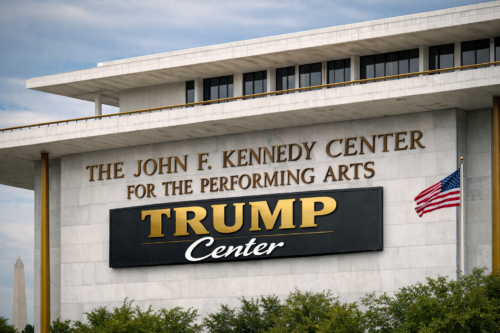
That distinction matters — especially in 2025, as controversy erupted after Donald Trump and his allies moved to attach his name to one of the nation’s most important cultural institutions: the John F. Kennedy Memorial Center for the Performing Arts.
The move triggered outrage, lawsuits, and a basic constitutional question that cuts to the heart of executive power in the United States:
Can a president — or a politically aligned board — rename a federally established memorial without Congress?
The answer is clear.
No. He cannot.
And the reason why exposes a deeper pattern of institutional overreach.
Kennedy Center Memorial Created by Congress, Not a Board
The Kennedy Center is not a private venue, a nonprofit theater, or a rebrandable cultural space.
It exists because Congress created it.
In 1964, Congress passed legislation establishing the John F. Kennedy Memorial Center for the Performing Arts as a living memorial to the assassinated president. The law did three crucial things:
- It created the institution
- It designated its official name
- It defined its purpose as a national memorial
That name — John F. Kennedy Memorial Center for the Performing Arts — is written directly into federal statute.
Which means only one body has the power to change it.
Congress.
Not the president.
Not a board of trustees.
Not an executive order.
Not a press release.
What Donald Trump and His Allies Tried to Do
In 2025, Trump-aligned appointees gained control of the Kennedy Center’s board. Shortly thereafter, signage and digital materials began appearing that added Trump’s name to the building and its identity.
Supporters framed it as a board decision — a routine governance move.
Legally, it was nothing of the sort.
The board does not possess the authority to rename a federal memorial created by statute. At most, it can make internal or cosmetic changes that do not conflict with federal law.
Legal scholars quickly pointed out the problem:
You cannot override a congressional act with a board vote.
That would be like renaming the Lincoln Memorial, Mount Rushmore, or Arlington National Cemetery because a board “felt like it.”
That’s not how law works in the United States.
Why This Isn’t a Gray Area
This is not a novel legal question.
Federal memorials are governed by authorizing statutes, and courts have consistently held that:
- Names established by Congress cannot be altered without congressional action
- Executive or administrative bodies may not contradict statutory language
- Symbolic or “unofficial” renaming does not carry legal weight
In other words, a board may hang a banner — but the law does not change.
And when a federal institution presents itself under a name that contradicts statute, it raises serious legal and constitutional concerns.
The Lawsuits and the Backlash
The attempted renaming sparked immediate legal challenges.
Members of Congress argued that the board exceeded its authority. Legal complaints asserted that the move violated:
- Federal law governing the Kennedy Center
- Separation of powers principles
- Restrictions on altering congressionally designated memorials
The Kennedy family itself condemned the move, emphasizing that the center was never intended to be a political trophy — let alone renamed for a living politician.
The backlash wasn’t just emotional.
It was legal.
Why This Presidential Overreach Matters Beyond the Name
This isn’t about aesthetics or ego.
It’s about power.
If a president can unilaterally attach his name to a congressionally established memorial, then the implication is chilling:
- What stops a president from renaming federal buildings honoring political opponents?
- What prevents executive control over national memorials?
- What happens to congressional authority if statutes can be bypassed through loyalty boards?
This is why the law is explicit.
Memorials belong to the nation — not to whoever holds power at the moment.
The Bottom Line on this Abuse of Power
Donald Trump cannot legally rename the Kennedy Center without Congress passing a new law.
Anything done without that authorization is, at best, symbolic theater — and at worst, unlawful misrepresentation of a federal institution.
The Kennedy Center’s name is not a branding choice.
It is a statute.
And statutes do not change because someone wants their name on the building.